Покращення кожного виробу одягу

Non-woven interlining is one of the most widely used support materials in garment production. It sits behind collars, cuffs, plackets, facings and waistbands, where it controls shape, crispness and handfeel without adding the cost or complexity of a woven or knitted base. Yet it is also a frequent source of production problems, such as bubbling, strike-through, stiff garments and poor wash performance, and these problems usually come from a mismatch between the interlining, the shell fabric and the fusing process, not from the material alone.
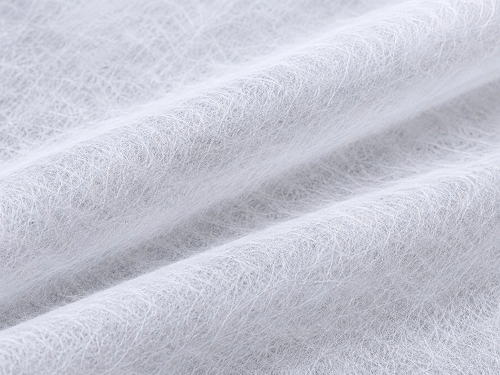
Non-woven interlining is made from a bonded web of fibres rather than from woven or knitted yarns. Because there is no yarn structure, the fabric has no true warp or weft direction. Its stretch, recovery and softness come from the fibre blend, how the web is formed and bonded, the weight, and the finishing and adhesive treatment applied afterwards.
Most garment-grade non-woven interlining is fusible: one face carries a heat-activated adhesive, usually applied as a pattern of small dots, which bonds to the wrong side of the shell fabric under heat, pressure and time. A non-fusible grade is sewn in or used as a loose layer instead. Always confirm which type a given model is before ordering.
Nylon (polyamide) and polyester are the two most common fibres, and many models blend them. Nylon-based webs generally feel softer and more resilient. Polyester-based webs tend to offer good dimensional stability and a firmer, drier hand. Blends aim to balance the two. These are general tendencies, not guarantees, so two models with the same fibre name can behave quite differently.
The fibre web may be formed by carding, spunbonding or other methods, and then consolidated by thermal bonding, chemical (resin) bonding or mechanical needling. Each route changes the density, surface smoothness and tensile behaviour of the base. Needled structures, for example, are bulkier and are used for felt-type products rather than light shirt interlining (see our needle punch felt range).
Garment non-woven interlining spans a wide range of grammage, from very light grades for sheer or delicate shells to heavier grades for structured parts. Heavier is not automatically better: a collar that is correctly supported at one weight can look stiff and papery one step up. Choose the lightest weight that delivers the required shape.
The adhesive polymer, dot size and dot density control bond strength, handfeel after fusing, and the risk of strike-through (adhesive passing to the face of the fabric) or strike-back (adhesive soaking into the interlining and weakening the bond). Finer dot patterns usually suit lighter, finer shell fabrics; coarser patterns give a stronger bond on heavier ones. For difficult substrates, specialist coatings exist, such as our PU coating interlining for special fabrics.
Our non-woven interlining range covers nylon, polyester and mixed constructions. The table below summarises how to think about the choice. The notes are general guidance, so always check the specification sheet of the exact model for composition, weight, width and adhesive details.
| Model | Fibre base | Typical character | Where to evaluate it first |
|---|---|---|---|
| Nylon Nonwoven Series 9 | Nylon | Soft, resilient hand; suited to garments where flexibility matters | Light and mid-weight shells, facings, soft collars |
| Nylon/Polyester Mixed Series 8 | Nylon + polyester | Balance of softness and stability | General-purpose collars, cuffs, plackets |
| Nylon/Polyester Mixed Series 5 | Nylon + polyester | Blended construction with its own weight and adhesive options | Where Series 8 is close but not an exact fit |
| Polyester Nonwoven Series 0 | Polyester | Stable, firmer, drier hand | Structured parts and cost-conscious volume styles |
Characterisations are general tendencies of each fibre type. Confirm exact properties on the model specification and by sample trial.
Non-woven is not always the right answer. Because it has no yarn structure, it is economical and easy to cut and handle, but it offers less directional control and, in most constructions, less stretch recovery than a knitted base. Choose by garment need:
Fusing quality depends on temperature, pressure and time, and all three must be set together. As a broad industry reference, many fusible interlinings are processed at roughly 110–150 °C for around 8–15 seconds under light to moderate pressure, but the correct window depends on the adhesive and the shell fabric. Treat these figures as a starting point only and follow the guidance for the specific model.
Always run the trial on the actual production fabric. Shell fabrics with finishes, coatings, high stretch, pile or heat sensitivity, such as some synthetics, can behave very differently from a standard cotton test piece.
A short, structured trial prevents most bulk-production problems. A sensible sequence is:
For reference methods, buyers commonly rely on internationally recognised standards: the ISO 9073 series for non-woven properties, ISO 6330 for domestic washing procedures, ISO 5077 for dimensional change in washing and drying, and ISO 3175 for professional dry cleaning. Agree the test method and conditions with your supplier in advance so that results are comparable.
| Defect | Likely causes | What to check or change |
|---|---|---|
| Bubbling or blistering | Shrinkage mismatch between shell and interlining, moisture in the fabric, uneven pressure, incorrect heat setting | Pre-shrink or relax the shell, dry fabric before fusing, verify press pressure and temperature at the bond line |
| Strike-through | Open or lightweight shell, excess heat or pressure, adhesive too heavy | Lower temperature or pressure, choose a finer adhesive pattern |
| Weak adhesion or peeling | Insufficient heat, pressure or time; finish or coating on the shell; wrong adhesive for the substrate | Increase dwell time within limits, test a different adhesive grade, run wash tests |
| Stiff, papery hand | Interlining too heavy or too firm for the shell | Step down in weight or switch to a softer fibre blend |
| Shrinkage or puckering after washing | Different dimensional behaviour of shell and interlining | Test the fused assembly through the intended care cycle before approving |
Brand requirements increasingly include recycled content and documented chemical compliance. If recycled material is part of your specification, review our GRS recycled interlining page and request the relevant documentation for your order. For garments that require easy-care performance, see our related article on washable non-woven interlining. For stitched or textured non-woven constructions, see special stitch nonwoven Series F.
Jiaxing Rainbow (UBL) Interlining Co., Ltd. supplies woven, non-woven, hair canvas and felt interlinings for garment manufacturers. Our approach is to match the interlining to your fabric and garment rather than to push a single standard product. You can learn more about our production process and quality assurance approach, or browse the full garment interlining catalogue.
To get the most useful recommendation, send us your shell fabric type and composition, the garment part, the care method and any target handfeel. We can then suggest suitable models and arrange fabric-matching samples for your own trial.
Is non-woven interlining always fusible?
No. Many garment grades are fusible, but non-fusible versions exist. Check the model specification before ordering.
Which is better for shirts: nylon or polyester non-woven?
Neither is universally better. Nylon-based grades usually feel softer, while polyester-based grades tend to be firmer and more stable. The right choice depends on the shell fabric, the desired collar feel and the washing method, so confirm by trial.
Why does my fused collar bubble after washing?
The most common causes are a shrinkage difference between shell and interlining, or an under-fused bond. Pre-relax the shell fabric and verify fusing conditions, then repeat the wash test.
Can one non-woven interlining suit every fabric?
No. Fabric weight, finish, stretch and surface all change how an interlining performs, which is why trialling on the actual shell is essential. Our interlining FAQ covers the trial process in more detail.
How do I request samples?
Use our contact form and include your fabric details and garment requirements.